As France celebrates the bicentennial of photography and Paris Photo, the leading international fair dedicated to photography and the image, prepares to welcome collectors from around the world, Christie’s is honored to present more than 350 photographs from the legendary Roger Therond Collection. The works will be offered across three sales: two in Paris on 13 and 14 November, and an online auction running from 6 to 17 November.
Roger Therond belonged to an exceptionally select circle of five great photography collectors of his time, alongside figures such as Marion Lambert and Thomas Walther. They formed a generation of explorers driven by a passion for adventure and played a pivotal role in renewing interest in photography. As Pierre Apraxine wrote in the foreword to Une passion française. Photographies de la collection Roger Therond (Filipacchi Editions, 1999), their efforts restored the dignity and brilliance of photographic treasures that had long been overlooked.
A journalist and the iconic editor of Paris Match for half a century, Roger Therond assembled an extraordinary collection of 19th- and 20th-century French photography. While his professional life brought him face to face with the most pressing events of his time, collecting offered an escape into authenticity, poetry and the hidden worlds revealed by the photographic medium.
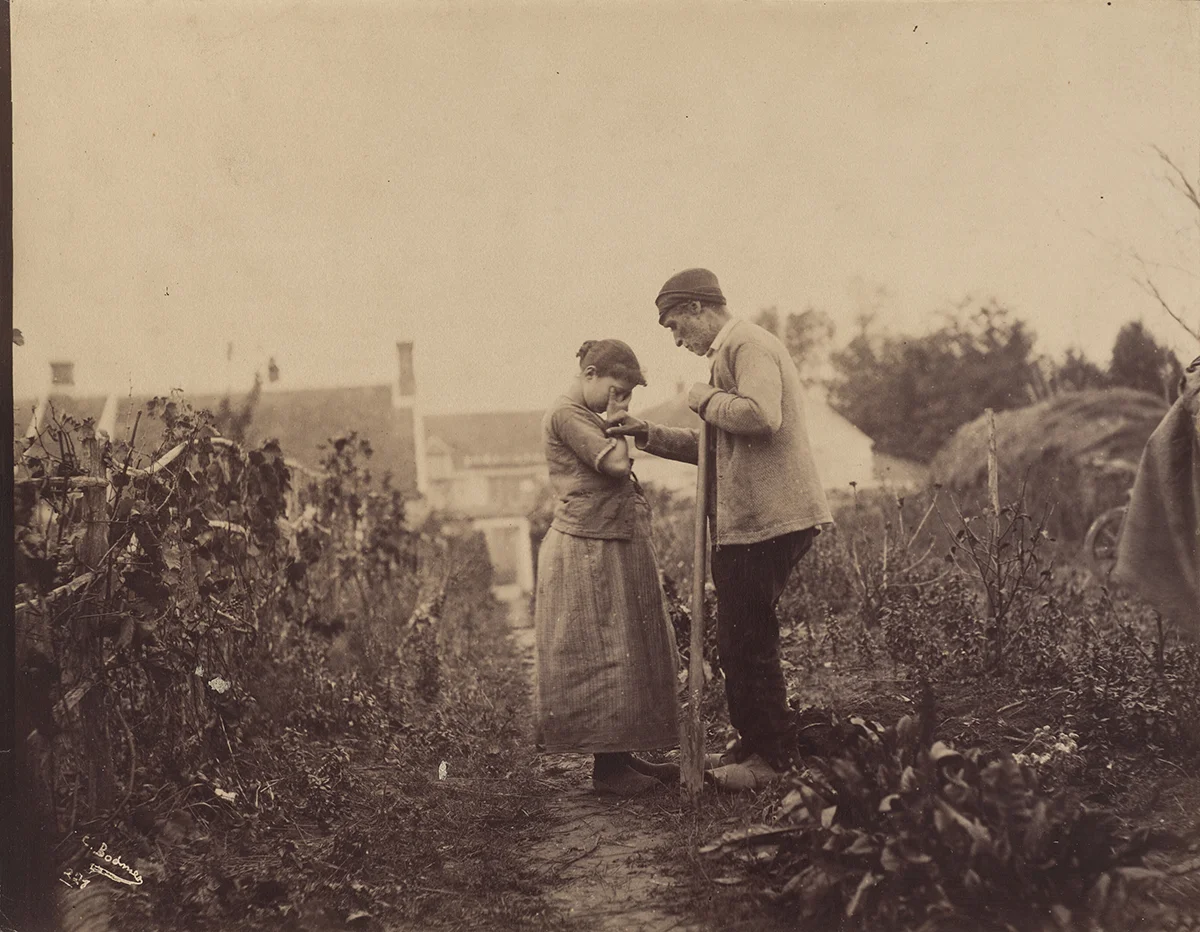
Untitled vers 1870 © Charles Bodmer
Therond's fascination with early photographic prints and proofs, whose tactile qualities delighted him, eventually extended to the experimental achievements of the 20th century. The collection includes works by artists who helped shape the history of photography, from Man Ray and Dora Maar to Brassaï, Henri Cartier-Bresson, Helmut Newton and Guy Bourdin, many of whom were his friends, as well as Maurice Tabard and Jacques-Henri Lartigue, two of his closest companions.

Hôtel de Ville et pont d'Arcole, Paris, vers 1855, 25 000-35 000 € © Baldus

Maison à Versailles, 1921. 80 000-100 000 € © Eugène Atget
The Birth of Photography: An Invitation to Travel
At the heart of the Roger Therond Collection lies a remarkable journey through the earliest chapters of photographic history. Collectors and connoisseurs will discover an exceptional group of works by 19th-century pioneers, including Auguste Belloc, Gustave Le Gray, Édouard Baldus and Nadar. The selection includes Hippolyte Bayard's early experiments with paper photography, some of the earliest daguerreotypes, including works by Baron Louis Gros, and the groundbreaking chronophotographs of Étienne-Jules Marey. A posed portrait of Gros and a photograph of the scientist with his sphygmograph illustrate the spirit of invention, curiosity and artistic ambition that shaped photography's beginnings.Among these visionary figures, Gustave Le Gray (1820–1884) occupies a singular place. His celebrated seascapes demonstrate remarkable technical mastery, particularly his use of two negatives to render both sky and sea with extraordinary clarity. These luminous images remain among the most poetic achievements of early photography. They also reflect Roger Therond's enduring attachment to the Mediterranean coast and to Sète, the port city where his own story began. More than beautiful views, Le Gray's seascapes embody the grandeur, mystery and boundless possibilities of photography itself.
Collectors will have the opportunity to acquire more than a dozen works by Le Gray, including Marine, Bateau quittant le port (€500,000–700,000), Le Port du Havre (1856, €300,000–400,000), Ciel chargé, mer Méditerranée (1857, €80,000–100,000), and Pont du Carrousel, vu du pont des Arts, Paris (1856–1858, €80,000–120,000).

Bateaux quittant le port du Havre, 1856, 300 000-400 000 € © Gustave Le Gray
The journey continues eastward with the personal album of Félix Teynard (1817–1892), comprising 160 photographic plates from his celebrated Égypte et Nubie (1858), published by H. Fonteny in Paris. Bequeathed to his son, Sixte, the album includes a handwritten note requesting that the work be bound in two volumes. Estimated at €300,000–500,000, it reflects Teynard's ambition to extend through photography the great scholarly enterprise of the monumental Description de l'Égypte, born from Napoleon's Egyptian campaign.
A diplomat, traveller and enlightened amateur, Baron Louis Gros (1793–1870) was among the earliest practitioners of the daguerreotype. In his photographs of the Acropolis of Athens, the familiar classical landscape takes on a dreamlike, almost lunar quality. Solitary and weathered by centuries, the ancient monuments appear suspended between antiquity and modernity. One such work is estimated at €60,000–80,000.

Autoportrait avec sa femme Ernestine et son fils Paul, vers 1863, 20 000 - 30 000€ © Nadar (Félix Tournachon)
Photography and Painting: A Dialogue That Continues to Resonate
One of the defining qualities of the Roger Therond Collection is its documentation of the moments when photography began to assert itself as an art form in its own right, moving beyond the simple recording of the visible world. Reflecting on this transformation, Roger Therond wrote: “There were the travelling photographers, but those who remained became princes of their studios. And as soon as photography became reproducible, commerce seized upon portraiture. The subject became little more than an object. Yet before its encounter with money, portraiture had its encounter with art. Nadar [...] saw men as they were, and as he himself was.”The portraits created by Adrien Tournachon (1825–1903) and his brother Nadar (Félix Tournachon, 1820–1910) embody this artistic ambition. Stripped of unnecessary artifice, their photographs reveal an uncommon intimacy with their sitters. Highlights include Nadar's Self-Portrait with his Wife Ernestine and their Son (€10,000–15,000), his portrait of the writer Alexandre Dumas (€10,000–15,000), and the strikingly theatrical Mime Deburau Grimacing, circa 1855 (€20,000–30,000). These images transform portraiture from a record of physical appearance into a form of psychological revelation.
The exploration of the human figure also led 19th-century photographers into the realm of the nude. Among the most daring was Auguste Belloc (1805–1873), a pioneer of nude photography whose work navigated the boundary between sensuality and the traditions of fine art. Although he largely succeeded in working within the moral restrictions of his time, he could not entirely escape official scrutiny. In October 1860, the morality police seized more than 5,000 photographs and stereoscopic views from his home, deeming them obscene. Only a handful of the images that once circulated discreetly under the counter survive today.

Deux albums de nus féminins vers 1850, 200 000-300 000 € © Auguste Belloc
Suspended between photography and painting, Eugène Cuvelier (1837–1900) emerges as one of the great poetic voices of 19th-century landscape photography. His images, rich in atmosphere and light, are believed to have influenced artists of the Barbizon School. Roger Therond recognized their importance long before international retrospectives brought Cuvelier wider recognition as one of photography's early masters. Among the exquisite salt prints in the sale are the haunting Dead Hare (€30,000–50,000) and A Plough (€20,000–30,000), works that transform humble subjects into timeless meditations on nature and rural life.

Rue Asselin, Paris, 1921, 80 000-100 000 € © Eugène Atget, Christie's Images Limited
Another Century, Other Journeys
Spanning the history of photography, the Roger Therond Collection continues into the artistic experiments of the 20th century. Eugène Atget (1857–1927) stands at the threshold of modernity, documenting a Paris on the verge of disappearance. His eerily still streets and sensitive attention to everyday life are reflected in Maison Close, Versailles (1921) and Rue Asselin, Paris (1921), each estimated at €80,000–100,000. These photographs reveal a gradual shift from straightforward representation toward a more poetic and subjective vision of the world.At the intersection of documentary observation and avant-garde experimentation, Germaine Krull (1897–1985) brought a radically modern perspective to the rapidly changing urban landscape. Her bold compositions and fascination with industrial structures are evident in Elevator of the Eiffel Tower (1926), estimated at €10,000–15,000. The vertiginous image captures the dynamism of a city being reshaped by technology.
Among the most innovative photographers of the 1920s and 1930s, Florence Henri (1893–1982) developed an aesthetic of remarkable formal precision. Through reflections, geometric constructions and unexpected shifts in perspective, she pushed photography toward abstraction. Her works Foire de Paris (1931, €15,000–25,000) and Pont Transbordeur, Marseille (1930, €10,000–15,000) reveal a world reorganized through the visual language of modernism.
A remarkable group of portraits by Man Ray (1890–1976) evokes the constellation of artists and cultural figures who animated interwar Paris. Among them are Kiki de Montparnasse (1924, €80,000–100,000), Peggy Guggenheim in a dress (1924–1925, €30,000–50,000), Max Ernst (circa 1935, €25,000–35,000), and Marcel Duchamp Playing Chess (1925, €30,000–50,000), inscribed by the artist with the name Rrose Sélavy. Together, these portraits form a compelling record of the creative energy that established Paris as a centre of the avant-garde.
Roger Therond affectionately nicknamed Man Ray “the Frenzied One” and was particularly drawn to Le Baiser (The Kiss), estimated at €250,000–350,000. Depicting two sitters, including Lee Miller on the left, the photograph invites multiple interpretations. Therond encouraged his children to step back and look again, asking whether they saw a man and a woman, two women, or two men wearing make-up. Rather than settle on a single reading, he invited them to half-close their eyes and discover a dancing silhouette, a black-clad figure whose skirt billows like a flower. The image opens onto another world, one of strangeness and mystery. It becomes less a portrait than a vision, suspended between reality and reverie.

Le Baiser, vers 1930-1931, 250 000-350 000 € © Man Ray 2015 Trust / Adagp, Paris 2026
Dora Maar occupies a central place in the sale with a group of photographs spanning documentary observation, Surrealist imagination and the artistic avant-garde of the 1930s. Her work reveals the remarkable diversity of her visual language, often marked by an unsettling sense of mystery. Highlights include Picasso with Bull's Skull (1937, €40,000–60,000) and Figurine pour le 29 rue d'Astorg (1936, €50,000–70,000), the photograph that would later serve as the starting point for her celebrated photomontage 29 rue d'Astorg.
Finally, Mannequin étoile (circa 1935) stands among Dora Maar's most poetic creations. Suspended between dream and enigma, the photograph achieved iconic status when the Centre Pompidou selected it for the poster of its major retrospective devoted to the artist in 2019. Like so many works in the Roger Therond Collection, it reminds us that the history of photography is not simply a history of images, but of visions: artists transforming the visible world into a realm of possibility, ambiguity and wonder.

Ascension du Mont-Blanc, les séracs des Bossons, 1862, 20 000 - 30 000€ © Auguste-Rosalie Bisson, Christie's Images Limited
Roger Therond's Photographer Friends
Among the photographers he counted as friends, Roger Therond had a particular affection for Jacques-Henri Lartigue, whom he called “the Blessed,” and Maurice Tabard, “the Secret One.” Reflecting on Tabard's work, Therond recalled: “Lartigue was my friend. Tabard too, I knew him well; we were almost neighbours. He was shy, withdrawn. He was afraid of people, of crowds; he worked quietly on his own. In every field, he somehow remained in the shadow of the great names, always overtaken by someone else, perhaps because he never quite believed in himself. I always loved his work. I was moved by the sense of solitude that defines it. He was something of a ‘Mr Unlucky’, but he deserves better. I would like his time to come at last.”A selection of around ten photographs from the collection invites viewers to rediscover the most fertile and inventive years of Maurice Tabard's career following his return from the United States. During this period, he developed the distinctive visual language that would establish him as a leading figure in European Surrealist photography. His Surimpression (Double Exposure) (1929, €30,000–50,000) exemplifies the technique that fascinated him and became one of the defining methods of Surrealist photography. In Tabard's hands, the camera no longer simply described the world; it created a space where realities overlap, dissolve and reinvent themselves.
The world of Jacques-Henri Lartigue, by contrast, is filled with joy, wonder and a playful appreciation of everyday life. Warm, spontaneous and often humorous, his photographs preserve moments of happiness against the passage of time. One celebrated image shows his cousin André Haguet, known as Dédé, diving into a lake in 1911 (€20,000–30,000). The photograph captures both the exhilaration of movement and the carefree spirit of youth.
Equally enchanting is Guitty, a photograph of his father's secretary's cousin running along the beach at Biarritz in 1905, seen from behind. Lartigue was only eleven years old when he took the picture, yet its spontaneity and grace already reveal the distinctive eye that would define his photographic work. The print is estimated at €20,000–30,000.
Roger Therond also acquired three prints depicting Renée, one of the most captivating figures in Lartigue's photographic world. Celebrated throughout his work for her extraordinary beauty, she appears in a 1931 portrait that embodies the elegance, lightness and effortless charm that so fascinated the photographer. The photograph is estimated at €25,000–35,000.
Through these images, Lartigue transforms fleeting moments into lasting enchantment, preserving not only faces and gestures but also a vision of life touched by happiness. Together, the works in the Roger Therond Collection offer a rich and deeply personal journey through the history of photography, from its earliest technical experiments to the modernist and Surrealist movements that reshaped the medium.

Sans titre (Mannequin-Etoile), vers 1935, Estimation : 100 000-150 000 € © Dora Maar, Adagp, Paris, 2026








 Instagram
 Facebook
 Pinterest
 X / Twitter