What makes us stop and look at something we might otherwise overlook? For British photographer Rory J. Lewis, the answer lies in the fascinating world of insects, where intricate forms, unexpected textures, and subtle details reveal a beauty that often escapes the naked eye. In his series Reverie of the Unseen, he brings these small creatures into focus, inviting us to discover a different perspective on the natural world.
Selected as the winner of All About Photo’s June 2025 Solo Exhibition, Lewis combines technical precision with an artistic sensibility to create images that are as intriguing as they are visually striking.
We spoke with Rory about his journey as a photographer, the experiences that led him to macro photography, and the ideas behind Reverie of the Unseen. He also reflects on what keeps him curious and the discoveries that continue to shape his work.
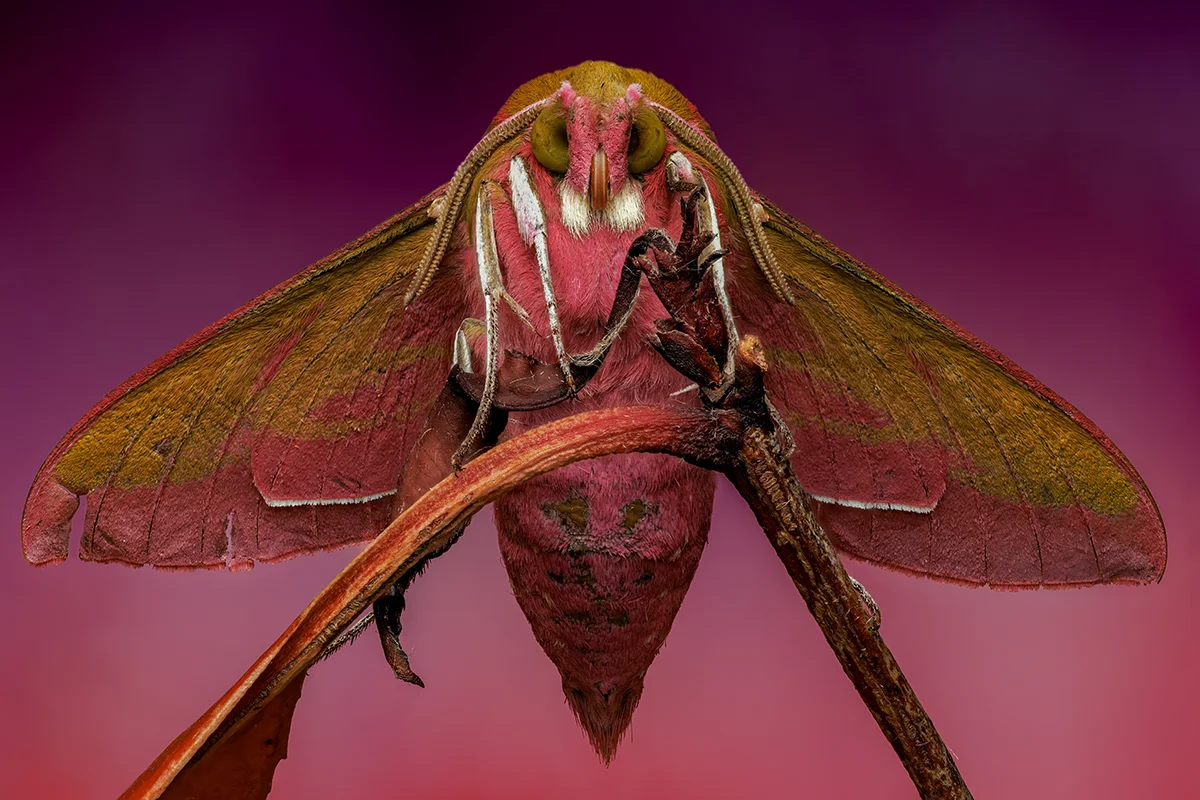
Elephant © Rory J. Lewis

Tonustus © Rory J. Lewis
Rory J. Lewis: Growing up in the Cotswolds I always had an appreciation for nature, but my father being a keen gardener, as well as a pretty talented hobby photographer, was probably the seeding ground for what I would end up doing.
How did your early experiences shape your interest in wildlife and macro photography specifically?
Landscape photography was my father’s favourite genre, and we would often accompany him as children on his missions to find the perfect beauty spots among the rolling hills. It was only a matter of time before he would put a camera in my hands, however his penchant for pointing out different species of insect and flower meant that while he was waiting for the perfect golden light, I was often pointing my camera directly at the ground.
What led you to focus on invertebrates rather than more conventional wildlife subjects?
The first time I focused on a spider through a macro lens it was like being instantly transported to another world, this creepy little scurrying mass of legs became an intricate work of art, with curious eyes, beautiful markings and a personality that is simply not visible in the same way through human eyes. It was absolute escapism, a journey into another realm, where suddenly you are very small, and the virtually unseen become giants, it was very cathartic for me.

Strawberry © Rory J. Lewis

Erraticus © Rory J. Lewis

Welk © Rory J. Lewis
Photography was never really a serious pastime for me at first, I would always take my camera with me, but it was more for having an excuse to spend time in the countryside, than the photography itself.
It wasn’t until a friend of mine entered one of my photographs into a competition without my knowledge that that changed. The photograph won, and gave me the confidence to maybe share some of my photography to the larger world.
Looking back, how do you feel your past education, mentors, and influences prepared you for projects like Reverie of the Unseen?
The photography communities within social media have had probably the biggest influence on me. On first posting my images to social media, I was amazed at the standard of some of the macro images on display there, techniques like flash-gun diffusion and focus bracketing were completely alien to me and so instantly inspiring. I could also see, however, areas in which it may be improved upon, at least to my liking, so I spent the next couple of years constantly refining my flash diffusion techniques, with different shapes and materials, as well as absolutely pushing the limit on the depth of focus brackets that could be achieved manually with the camera hand-held - away from tri-pods and rails, freeing me up for far more dynamic compositions. Every time I saw a photo from someone else that inspired me I would think, ‘how can I do that, but better’? It certainly didn’t happen overnight of course, but that journey I remember fondly, it became a bit of an obsession actually.
How do specific angles, lighting, or timing help bring out the character of these creatures in your images?
Looking back, one of the things I feel that really supercharged my images first came with the realization that time of day had a huge impact on what could be achieved in terms of capturing the subjects. Whereas I initially set-out at the most active time of day, when insects appeared most present, at the height of the afternoon, there was an abundance of things to shoot, but I found myself chasing them from flower to flower, or crawling around prone in the mud as to not surprise them. It was very difficult. Just by mere chance I set out at one day at 6am, and instantly found a dragonfly that would happily just sit there and allow me to shoot it to my heart’s content. It didn’t even occur to me at the time how these creatures slept, and how much they were affected by temperature. So next time I set out even earlier still. The challenges were different, many insects generally sleep out of plain view, so finding them in an accessible spot requires a lot more patience, but when you do, the approach is so much simpler, and really opens up what you can do with the frame. Once I had the time to position myself how I liked and play with different angles, it became apparent to me that many insects had a hidden ‘personality’ when viewed from certain directions. Their mouth parts could become a smile or a grimace, their antennae could create a frown or feign surprise, and pseudo-pupils appear in their eyes. This, to me, can create an almost human connection for the viewer that although merely implied, adds a whole new layer to these fascinating creatures.

Lesser Stag Close © Rory J. Lewis

Silvery Cutter © Rory J. Lewis
When spending a lot of time observing nature, it’s only a matter of time before you start to sympathise with these tiny animals, each of them exhibit completely unique and complex behaviours, and are absolutely dependent on very specific environmental conditions. But conveying this to the average person, whose relationship with invertebrates may not go far beyond letting a wasp out of a kitchen window, can be very difficult through mere photography, so adding that layer of anthropomorphism became a key element to my work.
I really desire for people to see beyond the scurrying bundle of legs, or the buzzing annoyance. Invertebrate wildlife is as key to a healthy ecosystem as any other animal on earth, and if I can move the needle of fascination just one tiny bit, then that brings me more joy than any other element of the craft.
How does the intersection of art and ethics guide your overall approach to wildlife photography?
The ethics of my photography is very important to me. I do my best to provide the minimum disturbance to the enviroments I shoot in. Most of my subjects are shot in situ, and my flash is heavily diffused and at the lowest power that is useable at the time. I will sometimes move a subject a very short distance to get a clearer view, but everything I shoot is very much alive, unharmed and in its natural habitat. The macro wildlife scene has been historically marred by techniques that you would simply never apply to other types of wildlife photography. Freezing, spraying, killing or pinning subjects in unnatural enviroments, to make life much easier for the photographer, or create scenes that are very unlikely in nature, is still, unfortunately, not all that uncommon. There are arguments for this, of course. Just driving a car to a shoot will kill insects on the way. But the work being a celebration of these creatures means it needs to rise above these archaic techniques, or something gets simply lost on the way I feel. I have received accusations of using these techniques myself, of course, mainly from other photographers who deem it impossible to get the images I get any other way, but I invite this dialogue. It’s always a great opportunity to discuss more ethical techniques, and how there are other ways to not only take images more responsibly, but also, I believe, get better results by doing it this way.

Megachile © Rory J. Lewis
Reverie of the Unseen came about firstly from a very small exhibition. A gallery in the heart of Berlin was doing an exhibition on A.I. generated works, and a lot of the work, although very interesting, was quite uncanny or bizarre. They wanted a small, separate, section of the gallery to be more aimed at children, and to act in absolute contrast to the rest of the works on display there, they believed my work would be a great fit. As it was aimed at children, I provided 10 of my most colourful and amusing subjects, it was a huge hit, and the gallery quickly motioned to discussing the possibility of extending it to a full solo exhibition.
So Reverie of the Unseen was born, 55 images of my most vivid and emotive subjects collected over the past 5 years.
What are your plans for publishing or exhibiting Reverie of the Unseen, and are there any upcoming shows or projects you can tell us about?
The live Solo exhibition ran until the end of 2025, and a selection of some of the best pieces can still be viewed online at AAP as well as my website. Work has already begun on my next project, I am currently working on a collaboration with a major camera brand, which has given me a lot of insight into film and more connecting the artist with the art. Something that seems to be all the more desired these days. But I will leave it there, as I simply can’t say any more than that for now.
For all those interested, there will be more updates on my Instagram in due course.

Demoiselle © Rory J. Lewis

Jewel Wasp © Rory J. Lewis

Nomada © Rory J. Lewis

Twist Wing © Rory J. Lewis








 Instagram
 Facebook
 Pinterest
 X / Twitter