Unlike many teenagers, my best friend Ondine and I didn't collect portraits of actors or singers. We collected black-and-white postcards of photography's masters. Our schoolbooks and bedroom walls were covered with images by Henri Cartier-Bresson, Marc Riboud, Willy Ronis, Robert Capa, W. Eugene Smith, Sabine Weiss... and, of course, Frank Horvat.
Those photographers were part of our world long before we could explain what drew us to their pictures. Looking at them, we began to notice how much could be conveyed through a gesture, a glance, or the arrangement of people in a street.
I wasn't familiar with Horvat's documentary photography, and The Birth of a Photographer introduced me to a period of his work I hadn't known. Published by Kehrer Verlag and edited by Karine Lisbonne, with texts by Horvat, Ranjit Hoskote, and Peter Pfrunder, it brings together around one hundred photographs from his journeys to India and Pakistan in 1952–1953 and his return to India in 1962. I found it a beautifully printed volume, one that explores the years before Horvat became known for bringing a photojournalist’s eye to fashion photography. Pfrunder's introduction establishes the historical and personal context of these journeys, drawing on Horvat's recollections to illuminate the experiences that shaped his early work. Bringing these photographs together for the first time, the book presents them not simply as the beginnings of a remarkable career, but as an independent body of work that reveals the foundations of Horvat's way of seeing.
At twenty-five, Horvat set out for Pakistan and then India, though his fascination with the region had begun much earlier. At sixteen, he had befriended Sikh men interned in a camp near his village. They taught him English and left him dreaming of India. Born into a Jewish family from Eastern Europe, Horvat had fled Mussolini's antisemitism with his mother and sister at eleven, finding refuge in Switzerland. Speaking several languages and accustomed to upheaval, he eventually felt compelled to venture beyond the security of his adopted home. As he later recalled, those years had left him with a "thirst for reality."

Women at a village well, Punjab, India, 1952 © Frank Horvat Studio

Khedda, near Mysore, India, 1953 © Frank Horvat Studio
From the very first pages, Pfrunder’s text makes the book especially engaging, as he recounts these early years through Horvat’s personal anecdotes. His stories reveal a life shaped as much by chance encounters as by deliberate decisions. In one memorable episode, he planned to take a train to Geneva to see his girlfriend but met another woman, Rosa, instead. He missed the train, and Rosa eventually became his wife. Together with the many quotations from Horvat, such stories bring immediacy to the narrative.
When Horvat set out for the Indian subcontinent in the spring of 1952, he carried a camera, money borrowed from his mother, and no clear plan beyond the journey itself. He chose to visit Pakistan first because the country's ambassador had promised him special treatment, hoping that favorable coverage might improve Pakistan's image abroad. The special treatment amounted to little more than a cup of tea.
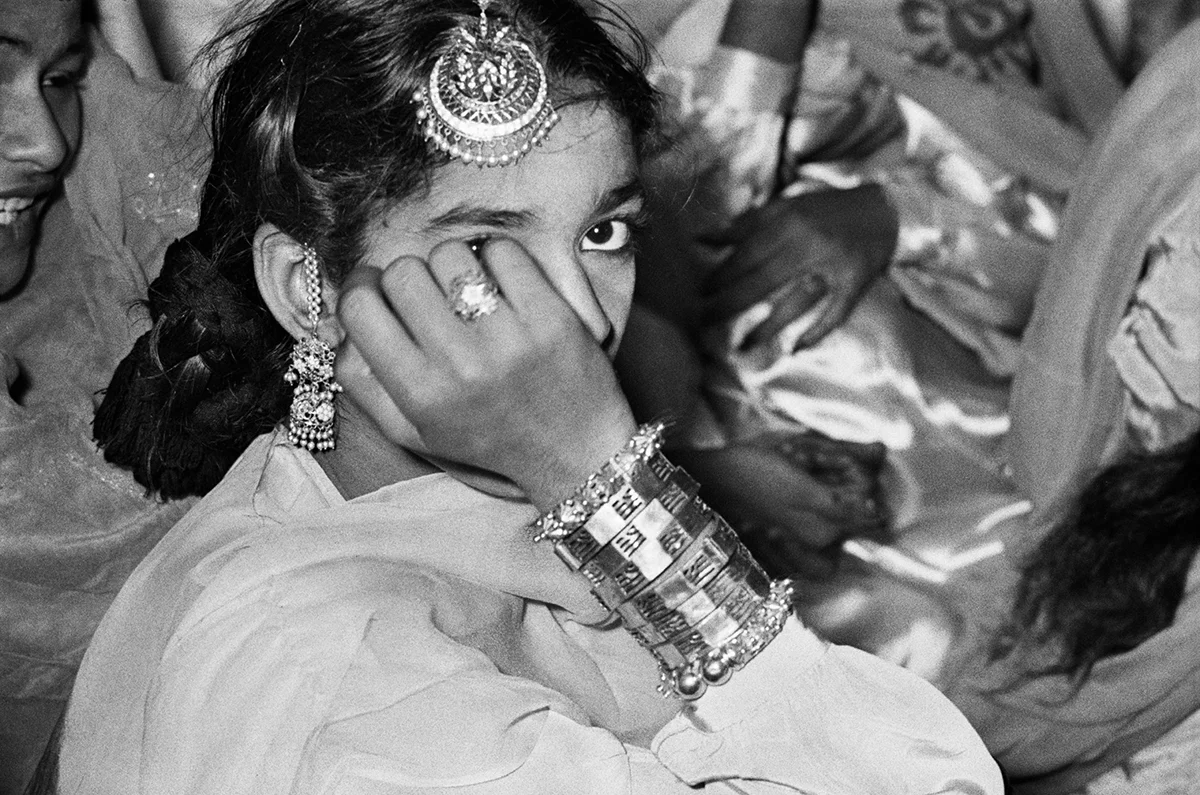
Red-light district of Hira Mandi, Lahore, Pakistan, 1952 © Frank Horvat Studio
The photographs from this journey offer glimpses of a world Horvat was still learning to understand, like the one reproduced on the book’s cover. Made in Lahore’s Hira Mandi, a neighborhood long known for its musicians, dancers, and courtesans, the photograph also appeared on the cover of Die Woche at the time. Horvat visited during a celebration, when women wore their jewelry and gathered with musicians and bodyguards. His photographs evoke a community whose artistic heritage coexisted with its association with prostitution.
Among these early photographs, one image stands out for its tenderness and formal elegance. One of the book’s most beautiful and memorable images is a Pakistani wedding portrait made in 1952. The bride lifts her veil and looks into a mirror, allowing the groom to see her face for the first time. We see her looking at herself as he would see her, while he remains outside the frame. The reflection gives the bride a presence of her own within the ritual, turning a formal occasion into an intimate encounter charged with quiet tension. Edward Steichen later selected the photograph for The Family of Man, the landmark exhibition at New York's Museum of Modern Art in 1955.

Husband discovering the face of his wife in a mirror, Lahore, Pakistan, 1952 © Frank Horvat Studio
Knowing Horvat's later career, I was tempted to look for signs of the fashion photographer he would become. But the photographs from India and Pakistan hold my attention for other reasons, particularly the unexpected ways people occupy a frame. Documentary photography reveals as much about the person behind the camera as about the world before it. What Horvat noticed, where he stood, and what he left outside the frame all became part of the picture.
That question of looking becomes more complex when we consider Horvat's position as a young European photographer encountering societies shaped by colonial histories and profound social inequalities. The photographs offer glimpses of lives he could observe but not necessarily fully understand. Sometimes, a look or a posture is all we have. A girl in a dark shawl looks straight up at the camera, one hand gripping her shoulder, her eyes wide and fixed on Horvat. The wooden post beside her and a child's cap cropped at the bottom edge make the frame feel close and slightly awkward. Her expression is neither a smile nor quite a pose; it has the stillness of someone holding her breath. By contrast, a young woman in a deep doorway, absorbed in handwork, seems unaware of the camera, or simply unconcerned by it. Framed by a thick wall, with hazy light outside, she appears to inhabit a world of her own. Where the first image makes us conscious of being looked back at, the second lets us observe someone who may not know we are there.

Karachi, Pakistan, 1952 © Frank Horvat Studio
I kept returning to the faces and gestures that the book cannot fully explain. The people Horvat photographed continued with their lives after he left, and the images preserve only a brief encounter.
This may be what Horvat meant when he wrote: "It seems to me that these images 'go beyond the subject', and more generally, that this trip was the true starting point of my journey as a photographer." Some of these photographs resist the kind of explanation a magazine story would have required. One landscape is almost swallowed by mist: a dark causeway cuts through the grey, tiny figures dot its length, and little else anchors the eye. It leaves us with an atmosphere rather than an event. In another photograph, a man stands ankle-deep in the sea in a dark blazer and white shorts, his hands pressed to his face in prayer. The skyline and scattered figures behind him provide little context, and the odd combination of clothes makes the scene feel almost staged. Yet the gesture is unmistakable. What remains is not a story but a moment of private devotion, an image that invites us to keep looking.

Man praying, Bombay, India, 1953 © Frank Horvat Studio
Horvat's first journey to India also changed his understanding of what he wanted photography to be. He made thousands of images, but only a small selection found its way into publications. Magazine requirements often favored a familiar kind of reportage: a clear narrative, a recognizable subject, and a story that could be easily understood and sold. Horvat gradually distanced himself from these expectations, seeking something beyond the conventional, easily marketable story. In October 1954, he returned home, but India remained in his imagination. It was there that he began to discover his own visual language and reconsider the conventions of photojournalism.
The book's layout also shapes the experience of looking. Full-page portraits bring us close to individual faces. In one double-page spread, two veiled women make the gutter part of the image: white fabric fills the space, while a hand at the mouth and sideways glances suggest a moment of whispering or shyness. The horizontal photographs ask for a different kind of attention, sometimes making me turn the book to follow the frame. The sequence moves between these encounters and the broader context of Horvat's travels without resolving every image into a single narrative. This makes the book feel less like a simple sequence of illustrations and more like an object to spend time with.

Women listening to Vinoba Bhave speech, Bihar, India, 1953 © Frank Horvat Studio
The decade between Horvat's two journeys offers another way into the book. His return to India in 1962 was very different from his first trip. By 1962, Horvat had greater technical control, particularly in his handling of framing and light. Working for the German magazine Revue, he traveled through twelve cities and spent only ten days in Calcutta. This was no longer the open-ended adventure of a young man following his curiosity, but a professional assignment shaped by a schedule and specific demands.
Yet the earlier pictures feel less settled, and I find that unsettledness compelling. Horvat seems to be working things out as he goes, responding to what appears before him rather than fitting each encounter into the demands of an assignment.
I find these differences more interesting than a neat progression from an inexperienced young photographer to an accomplished professional. Not every change represents progress, and not every early image needs to anticipate what came later. Horvat's sensitivity to gesture, movement, and the way people relate within the picture offers a revealing connection to the fashion photography for which he would become known. Yet his earlier work has its own identity, shaped by the encounters and circumstances in which it was made.

Soldiers, New Delhi, India, 1962 © Frank Horvat Studio
Time adds another dimension to these photographs. The places may have changed, and the people photographed may be long gone, but the images remain.
The chronology at the end of the book usefully situates these journeys within Horvat's career. The final images bring the story back to the traveler himself: a 1953 photograph of Horvat in India by Jean Deloche, followed by a blurred image of him on an elephant. The latter provides an unexpectedly informal note on which to end.
The English title, The Birth of a Photographer, suggests the beginning of a career. The French title, La naissance d'un regard (The Birth of a Way of Seeing), shifts the emphasis from the photographer to the gaze that was still taking shape during these journeys.
Returning to these photographs, I think again of those black-and-white postcards Ondine and I collected as teenagers. Horvat’s early work brings me back to that first fascination with photography, when the world still seemed endlessly available to the eye.

Calcutta, India, 1962 © Frank Horvat Studio

Beggar assembly, Calcutta, India, 1962 © Frank Horvat Studio









 Instagram
 Facebook
 Pinterest
 X / Twitter