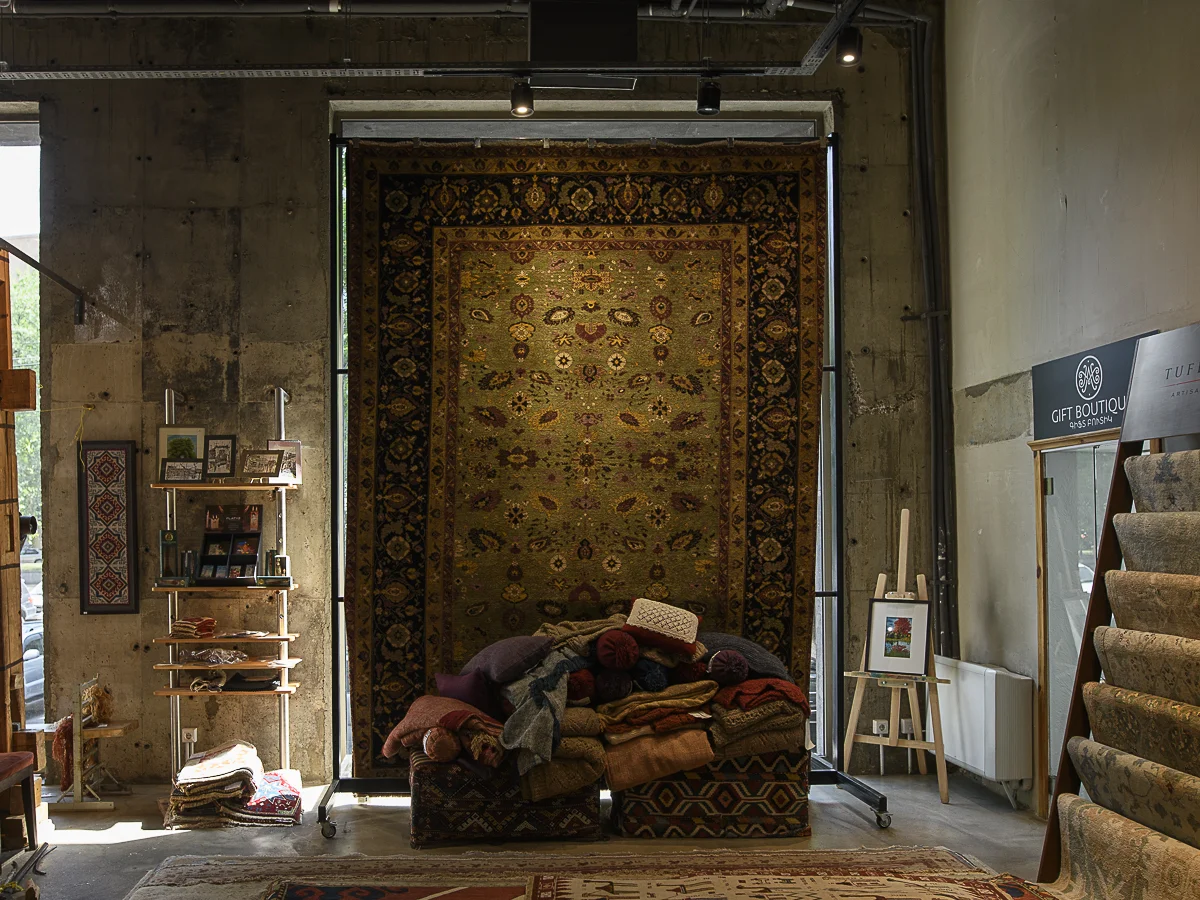
Armenian carpets are both object and witness. For Armenians, carpets are more than decoration or craft; they are maps of memory, folded and carried across borders and generations. Each knot records a gesture, a hand, a climate, a vanished room. Woven into their patterns are stories of villages that no longer exist, of homes left behind, of celebrations, grief, and everyday life.
Armenian carpets are a “portable homeland” – a small, movable territory of color and pattern that can be rolled up, carried, unrolled, and inhabited again in a foreign room. When land is lost or inaccessible, texture becomes a geography. The border of a rug becomes a threshold; the central medallion, a vanished courtyard; repeated motifs, the echo of a language spoken less and less loudly. In exile, you spread a carpet on the floor or on a wall and, for a moment, you are inside another country.
Carpets are not nostalgic props; they are active archives. They carry the imprint of migration, survival, and adaptation. By placing them in new contexts – on walls, in public spaces, in dialogue with digital media or everyday objects – is about asking how cultural memory persists, transforms, and risks being commodified. Who gets to own these patterns? What happens when a sacred or intimate object becomes a global aesthetic?
My aim is to make visible the labor of hands, women’s hands, that tied each knot and passed down skills quietly, across kitchen tables and in displaced homes. I am interested in how that labor functions as resistance: the refusal to let a pattern die, the insistence that a lost place can be traced in thread.
Through Armenian carpets, I explore what people carry home with them when the original ground is threatened or gone. My frames are conversations with and about carpets – attempts to listen to what they remember, and to extend those memories into the present tense.

© Ezio Gianni Murzi

© Ezio Gianni Murzi

© Ezio Gianni Murzi

© Ezio Gianni Murzi

© Ezio Gianni Murzi

© Ezio Gianni Murzi
© Ezio Gianni Murzi
Ezio Gianni Murzi
I was born in a family of seafarers and Navy officers for generations and I was the single one to study Medicine and become a medical doctor. I loved photography since my earlier days in the medical career and I became a photographer and passionate story teller after my going into retirement and after attending workshops run by Anush Babajanyan of VII Agency, John Stanmeyer of National Geographic, and by Salwan Georges of the Washington Post.In May 2024, I did an exhibition of my photographic story “Hospital of Hope” centered on my medical experience in Mozambique. My work captures the intersection of medical humanitarianism and raw human emotion, highlighting the fight against HIV/AIDS one person at a time, fight that is not only medical, but social as it provides patients and care givers, as the grannies of HIV-orphaned children, with a roof, food and little cash.
I recently got some small but valuable recognitions as I won an All About Photography competition and my frames were included in issue #55 of their magazine dedicated to Women. Another frame got First Place in a Phi International Award, category People Photography--Newborn/Maternity. A portrait of mine is included in dodho.com yearly book titled Portrait 2026. Two of my stories were given Honourable Mention in the Travel Section of the Global Lens Award that published a lengthy interview with me on their site.
expand_circle_rightgiannimurziphotography.myportfolio.com
expand_circle_right@giannimurzi
expand_circle_rightAll About Ezio Gianni Murzi

© Ezio Gianni Murzi

© Ezio Gianni Murzi

© Ezio Gianni Murzi

© Ezio Gianni Murzi

© Ezio Gianni Murzi








 Instagram
 Facebook
 Pinterest
 X / Twitter