From Hollywood stars and political figures to children, workers, fashion models and people living in some of the most remote places in the world, Eve Arnold spent more than five decades looking closely at people. Her photographs are often intimate, sometimes quiet and occasionally unexpected, but they are rarely distant. For Arnold, photography was not simply about recording what was happening in front of her. It was a way of getting closer to people and trying to understand them.
From 19 September 2026 to 31 January 2027, Fotomuseum aan het Vrijthof in Maastricht, the Netherlands, presents All About Eve, a major retrospective dedicated to the life and work of the legendary American photojournalist. The exhibition brings together 130 black-and-white and colour photographs from across Arnold’s remarkable career, with particular attention to the 1950s, 1960s and 1970s. Created in collaboration with Magnum Photos and CAMERA – Centro Italiano per la Fotografia in Turin, the exhibition offers an opportunity to rediscover a photographer whose work moved effortlessly between celebrity portraiture, social documentary, travel and photojournalism.
Born in Philadelphia in 1912, Arnold did not begin her photographic career through an elite art-school education. She became interested in photography in the 1940s and studied at the New School for Social Research in New York, where she took a class with the influential art director Alexey Brodovitch. Photography quickly became a profession, and Arnold began working in the great era of magazine photojournalism, photographing subjects ranging from ordinary working people to politicians and internationally known entertainers.
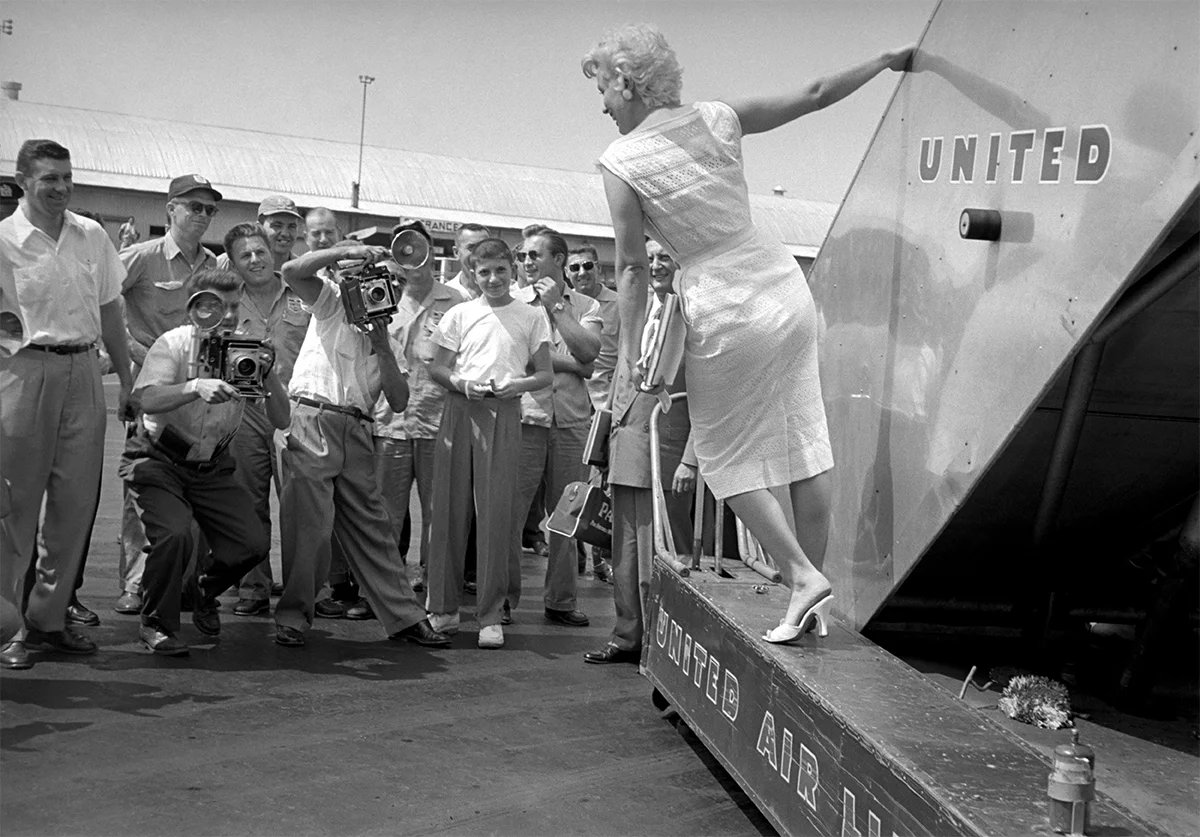
Marilyn Monroe before departing to Bement. NYC, 1955 © Eve Arnold - Magnum Photo
Arnold is perhaps most widely remembered for her photographs of celebrities. She photographed Marilyn Monroe extensively, including on the set of The Misfits in Nevada in 1960, and made memorable portraits of Marlene Dietrich and Joan Crawford. But what makes these photographs compelling is not simply the fame of the people depicted. Arnold often photographed them away from the polished image expected by the public: between takes, backstage, at home or simply absorbed in an unguarded moment. Her photographs allow the person behind the public persona to emerge.
This ability to look beyond appearances also shaped Arnold’s documentary work. She photographed Malcolm X, documented the civil rights movement in the United States and explored the lives of women in different parts of the world. Her series Fashion Shows in Harlem, for example, brings together fashion, culture and everyday life, while A Baby’s Momentous First Five Minutes observes the extraordinary intimacy of a child’s first moments after birth. New York by Night offers yet another side of her work, showing the city through a more atmospheric and observational lens.

Malcolm X at a Black Muslims rally. Washington, D.C., 1961 © Eve Arnold - Magnum Photo
There is a particular humanity running through Arnold’s photographs. She once described her approach to photography as a way of understanding rather than judging, and that idea can be felt throughout her work. Whether photographing a famous actress, a political activist, a mother and her newborn child or someone she encountered during her travels, she approached her subjects with curiosity and openness. Her photographs often feel less like images taken of someone than moments shared with them.
That quality is especially striking when looking at her portraits. Arnold had an unusual ability to make people appear both recognisable and vulnerable. Fame, social status or cultural differences could fall away in front of her camera. Her subjects were not reduced to symbols or headlines; they remained individuals. This human connection helped give her work an emotional depth that has allowed it to remain relevant long after the events and personalities she photographed have become part of history.

Marlene Dietrich singing at the recording studios of Columbia Records. NYC, 1952 © Eve Arnold - Magnum Photo
From the 1970s onward, Arnold increasingly turned toward books, producing publications including In China, In America, Marilyn Monroe: An Appreciation and The Great British. In 1980, In China received the National Book Award, reflecting the importance she placed not only on individual photographs but also on the long-form photographic story. Her writing was an important part of this later work as well. In her book In Retrospect, Arnold wrote extensively about her experiences, revealing how naturally storytelling extended beyond the camera.
Her photographs are now held in major international collections, including the National Portrait Gallery and Victoria and Albert Museum in London, the Metropolitan Museum of Art in New York and the Centre Pompidou in Paris. In 1995, she was made a Fellow of the Royal Photographic Society and named a Master Photographer by the International Center of Photography in New York.
More than a century after her birth, Arnold’s photographs continue to feel remarkably direct. They belong to a particular era of magazine photography, yet their strength does not depend on nostalgia. What remains is her way of looking: attentive, curious and deeply interested in people. She could enter the world of a Hollywood film set, a Harlem fashion show, a political rally or a remote village and find the same essential subject — human experience.
All about Eve brings these different sides of her career together, from her celebrated portraits and social reportage to her travel photography and lesser-known stories. Rather than presenting Eve Arnold simply as a pioneering female photojournalist or as the photographer behind some of the 20th century’s most recognisable faces, the exhibition reveals the breadth of her curiosity and the consistency of her human approach. Across more than fifty years, she used photography to get closer, to listen and, above all, to look at people with genuine attention.

Eve Arnold on the set of Becket. England, 1963 © Photo Robert Penn
Fotomuseum aan het Vrijthof, Maastricht, The Netherlands
19 September 2026 – 31 January 2027
The exhibition is organised in collaboration with Magnum Photos and CAMERA – Centro Italiano per la Fotografia. Guest curator: Nina Mika-Helfmeier.









 Instagram
 Facebook
 Pinterest
 X / Twitter