There is something wonderfully humbling about photographing nature. We can spend hours waiting for the right light, following a change in the landscape, watching an animal, or simply noticing something small that we might otherwise have walked past. And sometimes, almost by chance, we are given a moment we could never have planned.
This is what I love about nature photography: it asks us to pay attention.
For AAP Magazine #60: Nature, we received photographs that approach the natural world in countless different ways. Some images invite us to step back and take in the vastness of a landscape, while others bring us closer, revealing details, textures, forms, and moments that might easily escape our attention. Together, they show how diverse our relationship with nature can be — and how differently each photographer chooses to see it.
What makes these photographs compelling is not simply what they depict, but the way they see. A familiar place can become mysterious through light and composition. A fleeting moment can become unforgettable. Something ordinary can suddenly appear strange, beautiful, or entirely new.
Nature is never truly still. It is constantly changing, growing, moving, transforming, and sometimes disappearing. These photographs capture just a fraction of that ongoing process, offering moments of stillness within a world that is always in motion.
Choosing the 25 winners was, as always, a difficult process. We saw many different interpretations of the theme, each shaped by the photographer’s own experience, surroundings, and way of looking. The final selection brings together a diverse group of voices and visions, connected by a shared curiosity about the world beyond us.
I hope these images encourage you to slow down and spend a little time with them. Look closely, look again, and allow each photograph to reveal itself at its own pace.
These photographs also remind us of the extraordinary beauty and richness of our planet, and of the fragility of the ecosystems that sustain it. Nature is not something to simply admire from a distance — it is something we depend on, and something we need to protect. By seeing its beauty, diversity, and vulnerability, we are reminded of the responsibility we all share to preserve it.
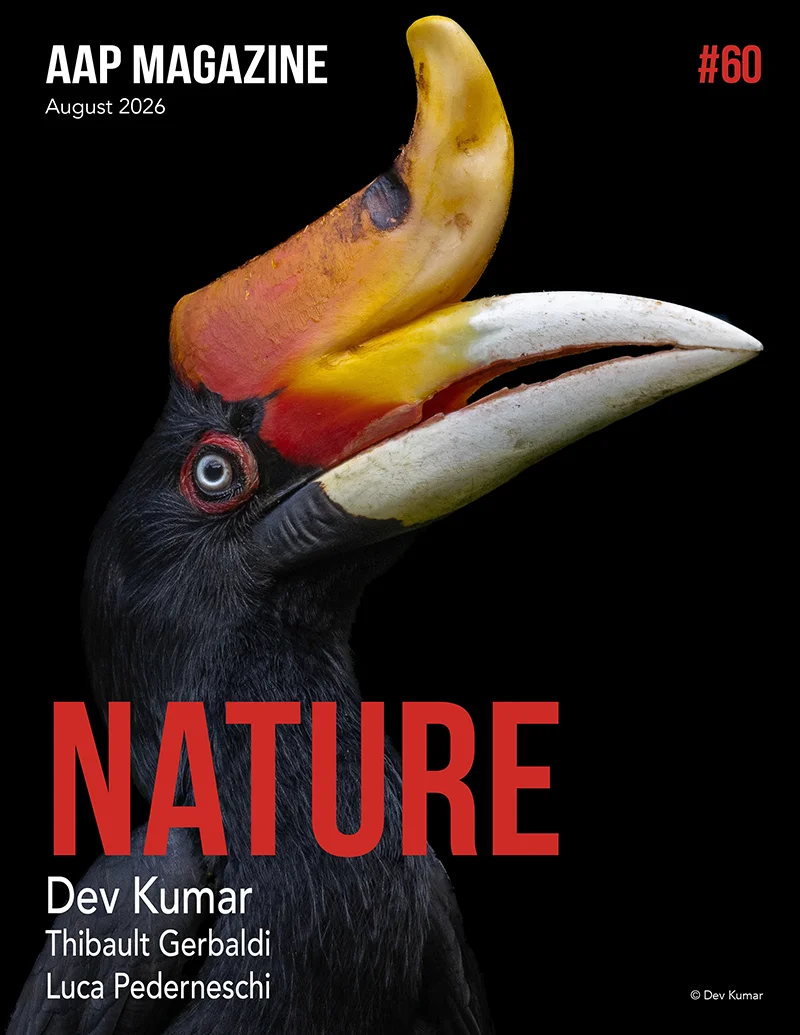
The Winner is Dev Kumar (Malaysia) with the series 'Unspoken'

Eyes Beyond the Frame from the series 'Unspoken' © Dev Kumar
Eyes Beyond the Frame portrays a rhinoceros hornbill, a distinctive species native to the forests of Southeast Asia, photographed in Malaysia. Set against a deep black background, the bird is isolated in vivid colour, its striking casque, powerful bill and intensely focused eye commanding the frame. Its head is tilted upward, directing its gaze beyond the boundaries of the image and leaving the object of its attention unseen. The minimalist composition removes the surrounding environment, allowing the hornbill’s remarkable form, colour and presence to take centre stage. The upward gaze introduces a sense of mystery and contemplation, inviting the viewer to wonder what lies beyond the frame.
Part of Unspoken, a collection of intimate wildlife portraits exploring the quiet language of expression, gesture, gaze and presence, the series seeks to reveal the individuality of animals through fleeting moments of observation.
expand_circle_rightwww.devkumarphotography.com
expand_circle_right@devkumar.photography
expand_circle_rightAll About Dev Kumar
The Second Place winner is Thibault Gerbaldi (France/United States) with the series 'Living Coastlines'

Living Coastlines © Thibault Gerbaldi
Commonly known as the "Dancing Trees" of Sumba, these mangroves have been shaped over decades by tides, currents, and prevailing winds. Their extensive root systems stabilize coastal sediments, reduce erosion, provide nursery habitat for fish and crustaceans, and help protect shorelines from storm surges. Mangrove forests are also among the world's most effective natural carbon sinks. Despite their ecological importance, these ecosystems continue to decline due to human activities.
expand_circle_rightwww.tgcrossroads.com
expand_circle_right@tg_crossroads
expand_circle_rightAll About Thibault Gerbaldi
The Third Place winner is Luca Pederneschi (Italy) with the series 'Lost Worlds'

The Last World from the series 'Lost Worlds' © Luca Pederneschi
Ancient mountain peaks stand silent against a sprawling starlit sky, while soft mist and distant celestial glows blend to evoke a profound feeling of timeless solitude. From the dramatic jagged peaks of the Dolomites to the wild horizons of Iceland, the work captures the magic and solitude of the night realm in all its quiet majesty.
expand_circle_right@luca_pederneschi
MERIT AWARD GALLERY
Alexej Sachov (Germany)

Shuttle from the series 'Starships'© Alexej Sachov
You would think that the Shuttle is an alien ship somewhere in deep space, photographed by the James Webb Space Telescope. It is part of my Starships series, with a colony, a transporter, a researcher, an interceptor, a warrior and other strange vessels floating among the stars. But it is not the case. The photographs were taken underwater in the open ocean, about one kilometer from the coast, early in the morning in the Maldives. The “spaceships” are small marine creatures, while particles and plankton in the water play the role of distant stars. And in one of the images, a small Nemo gives you a hint about the true location.
expand_circle_rightsachov-art.com
expand_circle_right@alexej.sachov
Thaddäus Biberauer (Austria)

Krokodil from the series 'What Remains'© Thaddäus Biberauer
This is an ongoing series that I started recently.
I am experimenting with different methods of physically altering and rephotographing my images while still keeping the subject recognizable.
The idea is to explore how the original image changes through this process and what remains in the end.
expand_circle_righthozzography.com
expand_circle_right@hozzography
expand_circle_rightAll About Thaddäus Biberauer
Jose Antonio Azcutia (Spain)

Relative 7 from the series 'The Gaze'© Jose Antonio Azcutia
Meeting an animal’s gaze is often a fleeting encounter, as they tend, for the most part, to avoid direct eye contact. With primates, however—our close relatives—something quite different happens. They hold our gaze with a disconcerting expressiveness, their eyes seeming to reveal emotions we instinctively recognize: the exhausted patience of a gorilla who appears to have grown weary of my presence, or the profound melancholy that seems to dwell in the eyes of an orangutan. Perhaps these are merely our interpretations, a way of projecting onto them something we know all too well ourselves.
This project was born from those moments. From the surprise of discovering, in wild eyes, gestures and emotions we feel we recognize. From the sense that, behind that gaze, there is something strangely familiar to us.
Perhaps that is what photography sometimes is: an attempt to preserve the precise moment when two gazes meet.
expand_circle_rightazcutia.com
expand_circle_right@azcu99
Christine So (United States)

Madrone Tree from the series 'And the Sun Will Rise'© Christine So
“Madrone Tree” was taken at sunrise on New Year’s Day two years after my husband died. Morning fog hides what’s round the bend, just as none of us can see what the future holds. I became a widow quite suddenly at an age when no one expected it, least of all my girls. The woods by my house have been my refuge and renewal. The title of my series, "And the Sun Will Rise," is part of a phrase by Victor Hugo, “Even the darkest night will end and the sun will rise.” We each have our own darkest night. Every one of my landscapes is a sunrise.
expand_circle_rightwww.christineso.gallery
expand_circle_right@christinesogallery
expand_circle_rightAll About Christine So
Seppo Tuomaala (Finland)

Passage from the series 'Pelicans of Kerkini'© Seppo Tuomaala
Passage was photographed at Lake Kerkini in northern Greece in January 2026. During this trip I concentrated on Dalmatian pelicans, exploring them both through close portraits and within the wider winter landscape. In this image, two pelicans fly low across the still water as the soft morning light and distant mountains are reflected around them. I was drawn to the balance between movement and stillness, and to the way the birds become part of the landscape rather than simply subjects within it.
expand_circle_rightwww.seppotuomaala.com
expand_circle_right@seppot_photography
expand_circle_rightAll About Seppo Tuomaala
Carmen Vranau (Romania)

Nocturne III from the series 'Nocturne' © Carmen Vranau
Nocturne is a series of botanical photographs exploring tulips as sculptural forms, suspended between opening and retreat. Set against a deep black background, each flower emerges through the interplay of light and shadow, revealing the subtle gestures, textures and changing contours of its bloom. In Nocturne III, the tulip turns sideways, its curved silhouette suggesting both movement and stillness. The series invites a slower contemplation of the natural world, capturing flowers not simply as botanical subjects, but as forms shaped by time, fragility and transformation.
expand_circle_rightwww.carmenvranau.com
expand_circle_right@carmenvranau
expand_circle_rightAll About Carmen Vranau
Aline Taieb (France)

Twilight Nature © Aline Taieb
That is how I set out to capture this fleeting, memorable moment—one I alone will rediscover and recognize through signs that will lead me back to a reality gone forever, like the tangible markers of an ordinary landscape deigning to be known; a landscape I recognized in Edward Steichen’s early photographs, such as *Moonlight*.
I wanted to align myself with Pictorialism and that movement of passionate photographer-artists who had gathered under the banner of the "Photo-Secession."
Much like Edward Steichen's early photographs from the late 19th century, my aim is to recapture the unique sensation of depicting these landscapes and to multiply their effects through a modern yet artisanal practice.
expand_circle_right@aline_taieb
Shawn Rosinski (United States)

Gathering of Fireflies from the series 'Fireflies!' © Shawn Rosinski
I’ve always been fascinated by fireflies (or lightning bugs). I try to share their magic for those that have not had the opportunity to experience it. I’m also hopeful my photography will inspire others to work to protect the environment so future generations may continue to enjoy these remarkable insects.
This photograph was a bit of an experiment. While I usually shoot fireflies with a wide-angle lens to cover as much ground as possible, I noticed a patch of my backyard that was especially thick with activity. I decided to swap in a fast, mild telephoto lens ( at ) to see how it would compress the scene. By stacking four 30-second exposures and focusing deep into the frame, the background fireflies stay sharp while the insects floating close to the glass melt into soft, luminous orbs—giving the image an almost three-dimensional depth.
expand_circle_rightafterdarkphoto.com
expand_circle_right@after_darkphotography
expand_circle_rightAll About Shawn Rosinski
Brian Overcast (United States/Mexico)

Bird Island, Culiacan, Mexico from the series 'The Unknown Landscape of Mexico' © Brian Overcast
Most photography of Mexico is vibrant and colorful, much like the country itself. That is how I photographed it for many years while working on travel assignments. Along the way, however, I quietly set aside other images—black-and-white photographs that felt more personal to me. I am now printing those images and, somewhat unexpectedly, rediscovering the same sense of anticipation I once felt in the darkroom. I call this series Unknown because it presents a quieter, less familiar Mexico—one shaped by light, landscape, and atmosphere rather than color.
Bird Island, Culiacan, Mexico is an aerial photograph taken in the soft light of early morning. At first glance, the island appears almost like lichen or some other organic mass. Only on closer inspection do the individual birds, mostly great egrets (Ardea alba), and trees begin to emerge, revealing the landscape for what it is.
expand_circle_rightbrianovercast.com
expand_circle_right@overcastinmexico
expand_circle_rightAll About Brian Overcast
Rivka Katvan (United States)

Watcher in the mist from the series 'On the Edge of Darkness' © Rivka Katvan
The Image Captures a solitary bird silhouetted against a dark stormy landscape
expand_circle_rightrivkakatvan.com
expand_circle_right@rivka_s_katvan
expand_circle_rightwww.facebook.com/rivkakatvan
expand_circle_rightAll About Rivka Katvan
James Krajicek (United States)

Elements of Life © James Krajicek
A young sapling emerges from a moss-covered rock, surrounded by dark, reflective water. A quiet meditation on resilience, renewal, and the enduring beauty of nature.
expand_circle_rightwww.jameskrajicekphotography.com
Yang Mo Lee (South Korea)

Veiled Peak from the series 'The Slow Undoing' © Yang Mo Lee
This is the Eastern Sierra in February, seen from the valley floor near Bishop. A storm had been running along the crest all morning, and for a few minutes the cloud came down the face of the mountain faster than it could clear — erasing the summit, then the upper bowls, then the tree line, until only the foothills and the dry sagebrush flat were left in the light. A minute later the mountain was gone completely.
I photograph the American West in winter because this is the season when the landscape refuses to hold still. The rock is permanent and the weather is not, and the picture worth waiting for is almost always the moment one is in the act of removing the other.
expand_circle_right@bestlym
expand_circle_rightAll About Yang Mo Lee
Julie Wang (United States)

Seeing Again © Julie Wang
I have photographed flowers for many years, yet I began this series with a simple question: how much do we actually see when we believe we already know what is before us?
I returned to dahlias—flowers I had photographed many times—and approached them as if encountering them for the first time. I removed their color and photographed each one directly, allowing form, texture, light, and the individuality of each flower to come forward.
The repetition became a practice of attention. The more closely I looked, the less repetitive the flowers became. Each revealed its own structure, gesture, and presence.
Seeing Again is not about making the familiar strange, but about resisting the assumption that familiarity means understanding. For me, these photographs are quiet reminders that even what we think we know can become new when we give it our full attention.
expand_circle_rightwww.juliewangsimages.com
expand_circle_right@juliewangsimages
expand_circle_rightAll About Julie Wang
Denis Churin (Russia/Portugal)

On the Threshold of the Sky © Denis Churin
"On the Threshold of the Sky" is a series of photographs in which I sought to express the overwhelming feelings that engulf a person at the summit of Mount Etna in Sicily ̶ literally surrounded by breathtaking clouds within arm's reach, near the smoking peaks and craters of a dormant yet never sleeping volcano. There, the insignificance and naive self-confidence of humanity as a species are felt with particular sharpness; tiny figures amidst otherworldly textures, smells, and a biting cold wind. They have climbed to the very threshold of the sky, unfearful of long-vanished ancient gods, yet each one freezes in silent awe, realizing the majesty of the views that have shifted their souls for the better from that moment on and will remain in their memory forever.
While working on this series, I utilized a custom digital emulation of the historical Soviet analog film Svema Photo 64, which I developed myself (a film I had the chance to shoot with when I first discovered photography back in 1990). This choice gives the imagery a dense, high-contrast tonal rendering and a fairly coarse grain; combined, this closely resembles a real film emulsion. Essentially, it is a deliberate rejection of the modern digital smoothness found in technically perfect images.
In this featured frame, the visual narrative reaches its structural culmination: a fragile column of pilgrims walking along the edge of a dormant crater against a monumental, smoke-shrouded peak. Conforming to the wabi-sabi philosophy, this unpolished, raw terrain serves as an almost immutable stage where human presence is recorded as a fleeting footprint on the very edge of a magnificent sky.
expand_circle_rightwww.denischurin.art
expand_circle_right@denis_wordman
expand_circle_rightAll About Denis Churin
Thibault Andrieux (France)

Vortex from the series 'Art’scalaphes' © Thibault Andrieux
“Is it a butterfly, is it a dragonfly?” Neither! It’s a owlfly, an insect well known to macro photographers, but generally much less familiar to the general public.
Its endearing, tousled appearance, very long antennae ending in clubs, and vivid colors make it particularly appealing. This helps insect photographers like me introduce these little creatures to an audience that might not otherwise be drawn to this strange and fascinating world.
Through macro photography, I can raise awareness of nature during my exhibitions and engage with visitors on broader topics such as ecology, biodiversity, and, in particular, my profession: biological control.
Advocating for nature through images!
expand_circle_rightthibault-andrieux.fr
expand_circle_right@thibault_andrieux.fr
expand_circle_rightwww.facebook.com/people/Thibault-Andrieux-Macrophotographie
expand_circle_rightAll About Thibault Andrieux
Teri Figliuzzi (United States)

Pause from the series 'The Color of Presence' © Teri Figliuzzi
This project is inspired by the quiet beauty of a hidden public garden above the Hudson River in New York. Using a Holga toy camera, images were captured, transfer printed on translucent tissue, backed with silver leaf, and hand-stitched with gold thread. The artist invites a slower, more attentive way of seeing, allowing small discoveries to emerge through patience and close observation.
expand_circle_rightwww.terifigliuzzi.com
expand_circle_right@terifigliuzzi
expand_circle_rightAll About Teri Figliuzzi
Ciaran Willmore (Ireland)

Branching Out from the series 'Natures Traces' © Ciaran Willmore
A delicate, branching pattern spreads across the sand of an Icelandic riverbed, looking almost like the limbs of a bare tree reaching out in different directions. Fine channels split and weave across the surface, creating a natural network of lines that branch and intersect. Shaped by the movement and retreat of the river, the pattern gently follows the path of the water, leaving its trace in the sand. It feels almost as though the river has drawn its own quiet sketch across the landscape.
expand_circle_right@willmoreciarani
expand_circle_rightAll About Ciaran Willmore
Beamie Young (United States)

Vase from the series 'Nature in Color' © Beamie Young
I have a garden that I visit daily, and among the herbs and veggies, I plant beds of
flowers. The ever-changing light inspires me to capture the beauty that I find in each
flower. The range of vibrant colors I witness changes in value moment to moment.
Each plant can appear different, and it is an endless display of beauty that inspires me
to share it with you.
expand_circle_rightbeamie.smugmug.com
expand_circle_right@beamie2
expand_circle_rightAll About Beamie Young
Jeremy Janus (United States)

Frozen in Time © Jeremy Janus
In February of 2026, I took a 6 day, 2,000 mile trip across Michigan to chase ice and snow. I took nearly 3,000 photos during my time there and one of my favorite subjects was the ice covered lighthouse in Saint Joseph. The second I saw this lighthouse I was mesmerized with the intricate formations of ice encapsulating this 35 foot structure. I shot this lighthouse in the early afternoon the day prior, but I decided to come back in the morning to shoot this before sunrise so I could capture it with the light shining through the night. When I got here around 6AM after driving an hour through the cold of night, it was freezing at 17 degrees with the wind kicking, but the scene could not be more captivating. The darkness was starting to dissipate, which was making shooting the lighthouse more difficult, but I stood there patiently until I could capture the light coming from the lantern room.
expand_circle_rightwww.jeremyjanusphotography.com
expand_circle_right@jeremyjanusphotography
expand_circle_rightAll About Jeremy Janus
Dario Bonetto (Italy)

Apparent Motion © Dario Bonetto
My images stem from geometrically sharp, rigorous field shots, where movement and atmosphere do not rely on in-camera chance, but on a conceptual transition achieved entirely in post-production, using the digital darkroom as a painterly palette. It is not the camera moving through time: it is my time settling onto the image. "Apparent Motion" is my personal invitation to slow down and share a dreamlike dimension that my mind remembered and dreamed.
expand_circle_rightdariobonettophoto.wixsite.com/dariobonetto
expand_circle_right@dario_bonetto_clickalps_photo
expand_circle_rightAll About Dario Bonetto
Turgay Uzer (United States)

Dreaming from the series 'A Day in the Life of a Leopard Cub' © Turgay Uzer
This year (2026), Mambo, a well-known leopard from Zambia's Lower Zambezi National Park, has a young female cub. She is only a few months old -- too young to be named -- but she has already become the favorite of safari photographers. It is easy to see why: She is photogenic, curious, and bold -- in other words, a natural photo model. She is still fully dependent on her mother (she will be for at least another year) but she does stray far as long as her mother is watching. In this photo story, I will illustrate a typical day in her life.
expand_circle_rightturgayuzer.slickpic.site
expand_circle_right@upgrademeforfree
Anuj Rawla (India)

The Pilibhit Charger © Anuj Rawla
Pilibhit is situated in the state of Uttar Pradesh, India. The tigers there are known to be larger than most Royal Bengal Tigers in India.
We were informed that a pair of mating tigers had been seen during the morning safari, so our guide decided to try to track them down. We went to the general area where they had last been seen but could not find them.
Finally, near the end of our safari, we decided to take one more round of the area. We spotted this huge male sitting in the bushes. He stood for a moment, looking at us, snarled, and then suddenly charged toward us.
expand_circle_right@anujrawla











 Instagram
 Facebook
 Pinterest
 X / Twitter