Some photographs make you stop scrolling. Others make you question whether you are looking at a photograph at all.
The 2026 BigPicture: Natural World Photography Competition, presented by the California Academy of Sciences, has once again turned extraordinary moments in the natural world into powerful visual stories. For its 13th annual competition, photographers from 64 countries submitted more than 7,400 images, capturing everything from elusive wildlife and underwater life to landscapes, insects, conservation, and the complicated relationship between people and nature.
At the center of this year's competition is a photograph that literally changes the viewer's perspective.
A polar bear seen from a seal's point of view
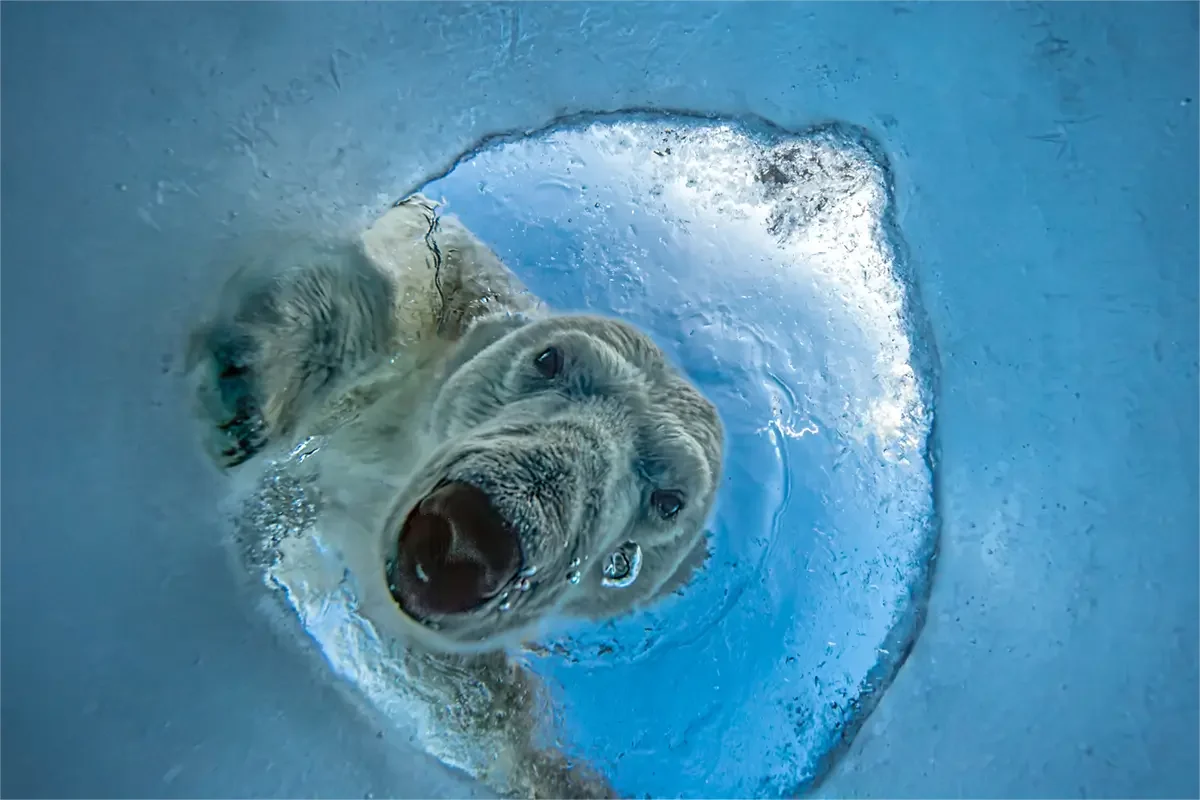
Grand Prize Winner: Polar bear (Ursus maritimus), International waters near Svalbard © Audun Rikardsen
The 2026 BigPicture Grand Prize went to Norwegian photographer Audun Rikardsen for A Seal's Last Sight, an extraordinary underwater photograph of a polar bear looking through a seal's breathing hole in the Arctic ice near Svalbard.
The image is remarkable not simply because it shows a polar bear, but because of where the viewer is placed. Instead of watching the predator from a safe distance, we appear to be looking up at it from beneath the ice—as if we were the seal waiting below.
That perspective was years in the making.
Rikardsen had dreamed of photographing a polar bear hunting seals from beneath the ice. After more than three years of planning and unsuccessful attempts, he finally found a seal breathing hole with fresh polar bear tracks nearby. He drilled through the ice, positioned an underwater camera directly beneath the hole, added a motion sensor, and waited.
Eight hours later, the bear arrived.
It pushed its head through the thin ice, looked directly into the camera, and then settled down to sleep above it. Rikardsen had to wait another nine hours before the animal moved away and he could safely retrieve his equipment.
The result is an image that combines patience, technical skill, suspense, and a touch of dark irony.
BigPicture jury chair Suzi Eszterhas described it as an exceptional perspective on a polar bear, praising the way the ice, water, and bubbles frame the animal's face. She also pointed to the extraordinary difficulty of making such an image in extreme conditions.

Terrestrial Wildlife Winner: Gelada (Theropithecus gelada), Simien Mountains National Park, Ethiopia © Marco Gaiotti
Seven Category Winners, Seven Ways of Seeing Nature
While A Seal's Last Sight earned the competition's top honor, the 2026 BigPicture category winners demonstrate just how broad nature photography can be. The winning photographs move from a murky pond in California to the Ethiopian highlands, the forests of China, and the tropical north of Australia.Anton Sorokin — Aquatic Life
For Aquatic Life, photographer Anton Sorokin won with Egg Clutch, an intimate underwater photograph of a California newt (Taricha torosa) laying eggs in a murky pond.
The scene captures a surprisingly unusual behavior. While spawning, the female newt grips whatever is nearby to anchor herself. Sorokin had visited the pond for years and seen thousands of newts laying eggs, but he says he had witnessed this particular behavior—gripping another female's previously laid egg clutch—only twice.
It is the kind of photograph that rewards close attention. What might initially look like an abstract underwater scene becomes a glimpse into a brief and rarely observed moment in the reproductive life of a native California amphibian.
Georgina Steytler — Art of Nature
Australian photographer Georgina Steytler takes a very different approach with Insect Art, the winner of the Art of Nature category.
Using long exposures beneath a street light in Australia's tropical north, Steytler photographed the flight paths of moths and grasshoppers. Instead of presenting insects as individual subjects, she transforms their movement into luminous trails and patterns.
Behind the beauty is also a conservation message. Steytler created the work to draw attention to declining insect biomass and the pressures associated with pesticide use. The resulting photograph makes an invisible world visible—a chaotic night of insect activity translated into something almost architectural.

Landscapes, Waterscapes, and Flora Winner: Río Tinto, Huelva, Spain © Juan Garcia Lucas
In the Landscapes, Waterscapes, and Flora category, Juan Garcia Lucas won with The Cave of Illusion, photographed at Spain's Río Tinto.
The image plays with perception. Viewed one way, the photograph resembles a cave opening onto a distant pine tree. Rotate it 180 degrees, however, and the illusion disappears, revealing the scene in an entirely different way.
It is a fitting winner for a competition built around changing perspectives. The unusual colors come from the Río Tinto landscape in Huelva, Spain, while the composition uses reflection and orientation to turn a real landscape into something that looks almost impossible.
Marco Gaiotti — Terrestrial Wildlife
Italian photographer Marco Gaiotti captured a gelada in midair for The Leap, winner of Terrestrial Wildlife.
The photograph was made in Ethiopia's Simien Mountains, where Gaiotti positioned himself at the edge of the escarpment around the times when the geladas moved between their sleeping and feeding areas. A dramatic storm was approaching as he waited for the right moment.
Beyond the visual impact of the airborne primate, the photograph points toward a larger conservation concern. Geladas are closely connected to the stability of the Ethiopian highlands, while political instability and conflict can make research, protection, and conservation work increasingly difficult.

Winged Life Winner: Eurasian eagle-owl (Bubo bubo), Venosta Valley, South Tyrol, Italy © Philipp Egger
The Winged Life prize went to Italian photographer Philipp Egger for Born of Silence, a tender portrait of two young Eurasian eagle-owls.
The siblings were photographed at a nesting site that has been used by generations of the birds. Egger had spent time observing their behavior and rhythms, allowing him to document a fleeting interaction without disturbing them.
One chick appears fierce, its beak open in what looks like a threatening call. But the apparent aggression is actually hunger. Beside it, the second owl appears quieter and more withdrawn. Together, the two young birds offer a glimpse of vulnerability beneath the formidable image of an adult predator.
Fernando Faciole — Human/Nature
The Human/Nature category winner, Orphan of the Road by Brazilian photographer Fernando Faciole, shifts the focus from wildlife behavior to the consequences of human infrastructure.
The subject is a giant anteater, a species whose population has been severely affected by collisions with vehicles. Faciole's photograph places the animal at the center of Brazil's first federal highway mitigation plan designed to reduce wildlife collisions. The Academy notes that such collisions have contributed to a halving of the giant anteater population.
Here, photography becomes more than documentation. The image connects one animal with a much larger question: how can roads, transport, and development coexist with wildlife?

Photo Story Winner: Pandas Gone Wild © Ami Vitale
This year's Photo Story winner is legendary conservation photographer Ami Vitale, whose Pandas Gone Wild follows decades of work surrounding the breeding, release, and protection of giant pandas.
Vitale's story spans three decades of conservation efforts and focuses on the painstaking process of returning captive-bred pandas to life in the wild. With fewer than 2,000 giant pandas remaining in the wild, the work is about far more than photographing an iconic animal. It is about whether conservation programs can rebuild viable wild populations and protect the bamboo habitats on which they depend.
For the project, Vitale immersed herself in the world of pandas and even wore a panda suit scented with panda urine at the Wolong Hetaoping Panda Center, where human contact with the animals is strictly limited. The unusual method reflects a serious principle behind the project: observe and document without allowing the animals to become accustomed to humans.
More than beautiful nature photography
What makes the BigPicture Natural World Photography Competition compelling is that its winning images rarely stop at beauty.There is beauty, certainly: a polar bear framed by Arctic ice, owls huddled together on a nesting ledge, a gelada caught in mid-leap, and insects tracing glowing paths through the night.
But there are also questions underneath those images.
What happens when wildlife and highways collide? What does political instability mean for conservation? Can endangered species be returned to the wild? What disappears when insect populations decline? And how much patience, preparation, and persistence does it take to witness a moment that may last only a fraction of a second?
The 2026 winners repeatedly show that compelling nature photography is not simply about being in the right place at the right time. It is about knowing the subject, understanding the environment, waiting for the unexpected, and sometimes returning again and again until the opportunity finally appears.
Rikardsen's polar bear photograph may be the clearest example. The final image looks almost effortless. In reality, it represents more than three years of planning, hours of waiting beneath Arctic ice, and an additional nine-hour wait after the photograph had already been taken.

Aquatic Life Winner: California newt (Taricha torosa, Contra Costa County, United States © Anton Sorokin
See the 2026 BigPicture winners in San Francisco
The winning and finalist photographs from the 2026 BigPicture competition go on display at the California Academy of Sciences in San Francisco beginning September 10, 2026. The Academy says the presentation includes 42 winning images and finalists, along with five videos across the competition's seven categories.For anyone interested in wildlife photography, conservation, biodiversity, or simply the extraordinary variety of life on Earth, the exhibition offers something more meaningful than a collection of spectacular pictures.
It offers new ways of seeing.
Sometimes that means looking at a newt beneath the surface of a California pond. Sometimes it means seeing insects as ribbons of light. Sometimes it means turning a photograph upside down to discover a completely different landscape.
And sometimes, for just a moment, it means seeing the Arctic through the eyes of a seal—with a polar bear looking back.
The full collection of 2026 BigPicture Natural World Photography Competition winners and finalists is available through the official competition gallery.









 Instagram
 Facebook
 Pinterest
 X / Twitter