I first discovered Ave Pildas's work through his submissions to AAP Magazine, where he was selected as a winner. Since then, I have continued to discover his incredible work through his other submissions, our interview about his book Star Struck, and Bijou Thoughts, a project we also presented on All About Photo. Over the years, I have also had the pleasure of getting to know Ave through our exchanges, and his warmth, kindness, humor, and liveliness have always come through. Looking at Africatown, I found myself recognizing something of that same spirit in his joyful portraits.
There are photographs that observe a place, and there are photographs that make us feel we have entered it. In Africatown: Sunday Market, Leimert Park, Los Angeles, Pildas does something more intimate: he allows us to meet a community through the people who animate it.
The project began almost by chance, after Pildas attended a jazz benefit concert in the neighborhood. He returned the following Sunday with his camera, and what might have been a single visit became a relationship lasting more than two years. He kept coming back, photographing vendors, musicians, activists, performers, families, and regulars. Just as importantly, he brought prints back to the people he photographed. At first, some were understandably suspicious of the photographer with a camera. Over time, that changed. People began recognizing him and calling out, “Picture Man.”
That small detail says so much about the photographs. Pildas was not simply taking pictures from the outside; he was giving something back. The photographs became part of an exchange, and eventually part of friendships. His subjects are not anonymous representatives of a social subject. They look back. They smile, pose, perform, challenge, dress up, and hold their ground. The camera becomes an invitation to participate rather than simply an instrument of observation.

Mya Baker © Ave Pildas
Another portrait has a different kind of presence. A woman dressed in white lace stands confidently against a rough urban wall, her sunglasses and carefully chosen accessories adding a touch of theatricality. The strong midday light intensifies the contrast between her elegance and the surroundings. She seems to have created her own stage, and Pildas simply gives her the space to occupy it.
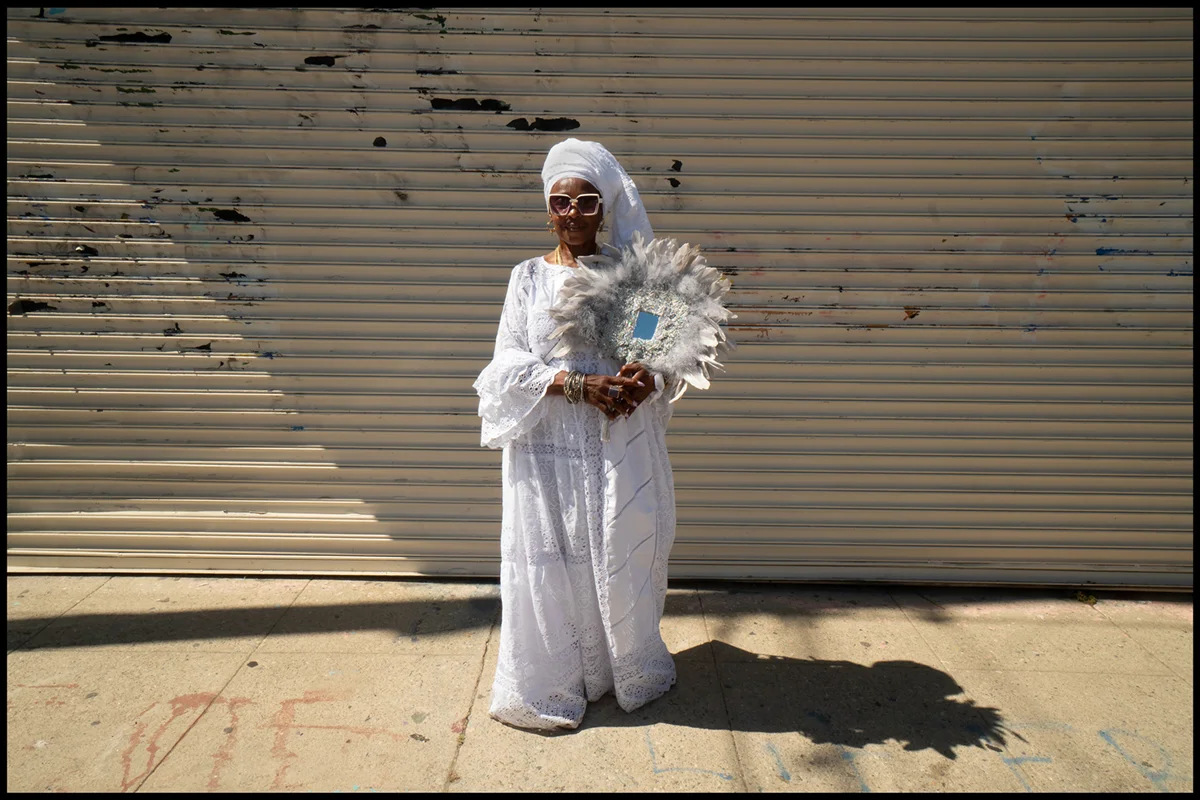
Goddess © Ave Pildas

Levi ProFit (Smoking) © Ave Pildas
This is where the book's joy becomes so convincing. It isn't simply a matter of bright color or smiling faces. It comes from the feeling that the people in front of the camera are participating in the picture. Pildas's own liveliness seems to meet theirs. His portraits can be playful and theatrical, but they rarely feel imposed. There is a genuine sense of connection.
That quality connects Africatown to the broader trajectory of Pildas's career, while also marking an important difference. Star Struck, his celebrated series made on Hollywood Boulevard between 1972 and 1975, is rooted in black-and-white photographs of a very different kind of public stage. Hollywood is built around performance, fantasy, and the desire to be seen. Africatown, made more than fifty years later, is in color and rooted in a living community whose energy comes from cultural memory, commerce, music, creativity, and everyday interaction. The two bodies of work share Pildas's fascination with character, but the emotional register has changed. The theatricality remains; the relationship has deepened.

Double Victor Taylor © Ave Pildas

Melinda Simon © Ave Pildas
Yet the photographs I find most compelling are not necessarily the ones that explain Leimert Park. They are the ones that leave something unexplained. A striking pose, an unusual character, an unexpected gesture, or a charged encounter can remain open-ended. We may not know the entire story of the person in front of us, but we sense that there is one. The photograph becomes an invitation rather than an answer.
That openness is particularly important in a project dealing with a place carrying such a rich history. Leimert Park has long been an important center of African American cultural life in Los Angeles, and the Sunday African Marketplace brings together people and traditions from across the African diaspora. Readers looking for a deeper historical account of Leimert Park's role in Black Los Angeles may want more context than the photographs themselves provide. But that is not really Pildas's ambition. His strength here lies in portraiture, presence, and encounter.

Khufu & Son (Qebehsenuf) © Ave Pildas

Wadada (Conguero) © Ave Pildas
Published in 2026 by The Pildas / Green Foundation, Africatown is the foundation's first release. The 112-page book contains 97 color photographs and was designed by Pildas and Lauren Mitzelfelt. What stays with me, though, is less the book's physical substance than its intimacy: the feeling of turning pages and encountering one person after another, each photograph holding a small moment of recognition.
There is something especially moving about seeing Pildas continue to work this way after such a long career. He is still going out, meeting people, making pictures, and allowing himself to be surprised. Africatown doesn't feel like a retrospective gesture. It feels alive and present. The book is less concerned with looking back than with paying attention to what is happening now.
For me, that is what makes Africatown such a natural continuation of the Pildas work I have been discovering through AAP over the years. The locations and subjects change, from Hollywood Boulevard to Leimert Park, from the fantasy of celebrity to the everyday vitality of a community. What remains is his interest in people and his willingness to engage with them.

Bamboo Flute © Ave Pildas

Fatherhood © Ave Pildas
Africatown: Sunday Market, Leimert Park, Los Angeles is ultimately a record of those encounters. The people in these photographs are not simply being documented; they are being met. And perhaps that is why the book feels so joyful. Behind the camera is a photographer who kept showing up until he was no longer simply “the photographer,” but “Picture Man”—someone familiar, welcomed, and expected to return.
Having first discovered Ave Pildas through his work submitted to AAP Magazine, it is a pleasure to encounter this new chapter of his work. Africatown is a beautiful reminder that photography can preserve not only what a place looks like, but something of how it feels to be there—and, sometimes, what it means to be welcomed into it.

Tannie © Ave Pildas

Tannie © Ave Pildas










 Instagram
 Facebook
 Pinterest
 X / Twitter