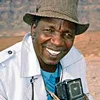
“As a rule, when I was working in the studio, I did a lot of the positioning. As I have a background in drawing, I was able to set up certain positions in my portraits. I didn't want my subjects to look like mummies. I would give them positions that brought something alive in them.”
-- Malick Sidibé
When Guillat closed his studio in 1957, Sidibé began photographing Bamako's young people at surprise parties, nightclubs, concerts, sports events and on the banks of the Niger. Using flash and a 24 × 36 Foca Sport for candid work, he recorded the dances, clothes and music of a generation, as in Nuit de Noël, Happy Club (1963). In 1962 he opened Studio Malick in the Bagadadji neighbourhood. He continued this reportage until 1976, when fewer parties, cheaper cameras and automated processing labs reduced demand. He then concentrated on studio portraits, ID photographs and camera repairs. Drawing on his training, he posed sitters actively, so that, as he put it, they would not look like mummies. His studio work under tungsten light includes the Vues de dos portraits of sitters photographed from behind.
“We were entering a new era, and people wanted to dance. Music freed us. Suddenly, young men could get close to young women, hold them in their hands. Before, it was not allowed. And everyone wanted to be photographed dancing up close.”
-- Malick Sidibé
Sidibé was well known in Bamako for decades but reached Western audiences only after meeting the French curator André Magnin in 1994. His first exhibition outside Mali followed that year, and Magnin edited the monograph Malick Sidibé (Scalo, 1998). His work has often been shown alongside that of Seydou Keïta, notably in You Look Beautiful Like That (2001), and with Keïta and Samuel Fosso in Portraits of Pride at Moderna Museet in 2002. He received the Hasselblad Award in 2003, and in 2007 he became the first photographer and first African to win the Venice Biennale's Golden Lion for Lifetime Achievement. An ICP Infinity Award followed in 2008, and a World Press Photo prize in 2010. His pictures are held by the Museum of Modern Art and the J. Paul Getty Museum. They also influenced Janet Jackson's 1997 video "Got 'til It's Gone." He died in Bamako in 2016.












 Instagram
 Facebook
 Pinterest
 X / Twitter